
Document Number DN 003.1/2025
This statement covers The Fruit Box Group’s commitment towards promoting a workplace that values diversity, equity and inclusion.
Covering Period FY 23/24
Introduction
The Fruit Box Group Pty Ltd (TFBG) has participated and provided data to Workplace Equity Gender Agency (WEGA) since 2013. Under revised legislation, all private companies in Australia with 100 or more employees will have their gender pay gap published. TFBG welcomes and supports these changes to create accountability and faster change across all industries in addressing gender pay gap issues within Australia.
TFBG Strategy
TFBG, we encourage, value and leverage the diversity of people, and perspectives to achieve maximum business performance. It is critical to our success that we have a workforce as diverse as our customers. Focusing on diversity and inclusion supports our business strategy by attracting top talent and improving our decision-making. Our engaged and inclusive teams encourage people to share their diverse insights and perspectives to help drive innovative solutions that accommodate our customers’ needs.
Gender Composition by Quartile
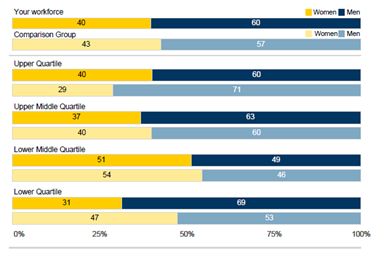
The chart divides employees into four equal quartiles. There is a disproportionate concentration of men in the upper quartiles and/or of women in the lower quartiles that has driven a positive gender pay gap for FY 24/25.
The comparison group that TFBG is allocated to is an industry that primarily attracts men and therefore there is a disproportionate concentration of men in our gender composition graph.
2024-2025 Understanding the Gap
Equal pay is our legal obligation that is to give equal pay for equal work. Our current Gender Pay Gap (GPG) is not a result of equal pay issues, as we have a gender-neutral approach to pay across all levels of the workforce as defined in TFBG’s Enterprise Agreement.
While we maintain a focus on increasing the number of women in senior positions, we also strive to uphold our guiding principle in which appointments are based on merit regardless of gender. TFBG’s average total remuneration pay gap is 5.6% (slightly higher than 5.4% for FY24). This indicates that men are paid more on average than women but our data indicates that this relates to part-time work and how long employees have been in their roles. However, TFBG’s 24/25 GPG is low compared to the industry benchmark data of 9.8%. The industry comparison group is generated by a combination of the Australian & New Zealand Standard Industrial Classification (ANZSIC) industry class and equivalent sized organisations. ANZSIC is the national framework used to classify industries according to the primary activity. TFBG’s primary industry is noted as 4122, Fruit & Vegetable Retailing.
Pay gaps are not solely driven by gender alone, but are also affected by experience, part-time work and how long employees have been in their roles. There is an unequal participation in part-time work and this statistic is skewed towards women. The gender pay gap is the difference in earnings between women and men.
TFBG’s Enterprise Agreement 2022–2026 (EA) is in operation and differentiates compensation between job levels, not gender with wage increases applying to all under the scope of the EA. In our workforce, more men hold roles that attract higher remuneration and/or have access to significant overtime, shift premiums.
Longer tenure typically correlates with higher remuneration and career advancement. At TFBG, the average tenure of males is approximately 4.5 years longer than the average tenure of females. There is unequal participation in Parental leave and only the female workforce have utilised this type of leave making women’s overall earnings being negatively impacted by the periods of unpaid parental leave.
The current data also confirms that out of the eight categories that WGEA collect data for our GPG is equal or closer to zero than the midpoint for comparison employer GPG e.g. For FY24/25 the GPG for our managers is 4.5% whereas the comparison group GPG for the same period is 17.9%.
We regularly review data relating to tenure, engagement, recruitment, succession, and uptake of flexible working options by women and men to monitor that our policies and practices are getting the right results. We are committed to regularly monitoring remuneration pay gap, as equal pay is our legal and moral obligation.
Actions and Strategies to Address our Pay Gaps
We know that achieving gender pay equity takes time, with focused and sustained effort. TFBG is committed to sustained action and continues to implement key initiatives to address our gender pay drivers including:
i. reviewing internal policies and procedures ensuring we maintain compliance, promote fairness and foster a positive workplace culture.
ii. actively supporting all genders to maintain positions of seniority if they choose to work part-time or requesting flexible work arrangements.
iii. employment terms include conditions and practices relating to flexible working arrangement for employees and to working arrangements supporting employees with family or caring responsibilities
iv. continue to conduct our annual internal checks to consistently review and track our pay gap progress to inform our action plan.
v. monitoring career progression, including promotions, training by gender.
vi. our strategy and practice is to give prompt and genuine considerations to any matter raised in the workplace. Our EA also contains a clause that requires us to consult with employees about a major workplace change that is likely to have a significant effect on them. Employees are provided with information and invited to give their views for consideration.
Disclosure
This statement confirms that the published information is accurate as at the time of publishing.